London July 2026
London, July 2026
Despite its proximity to my home in Ireland, London is a destination I have only visited twice before in my lifetime. The first time was in the early noughties, when I went over with my younger brother for a few days while he prepared himself for a summer working as a barman in The Star Tavern in Belgravia, a pub famously associated with the Great Train Robbery of 1963.
The second time was a decade later for a stag do. On neither occasion was I remotely interested in street photography. I was just there for the experience and the craic, as we Irish would say.
This trip was different. I’m much longer in the tooth now and have a different mindset. When visiting big cities around the world, I now want two things from the experience: the first is always photography, followed closely by visiting as many art galleries as possible in the time I have.
I planned a four-day trip, basing myself on Grimsby Street in Shoreditch, just off Brick Lane. I primarily chose the area because of its proximity to Liverpool Street Station, where you can get the train to Stansted Airport. My apartment was just a 15-minute walk from the station and a 13-minute walk from Aldgate East Underground station on the District line.

Shoreditch and Street Photography
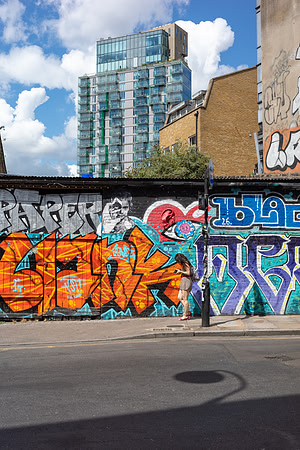
To be honest, I didn’t really know much about the area apart from some scant research online. I was pleasantly surprised when I got there by the amount of quality graffiti and the hip, urban, youthful vibe of the place.
Shoreditch is well worth a visit if you are in London and planning to do some street photography. The area oozes creativity, with some of the finest street art I’ve seen in an urban area. This acts as a perfect backdrop to a hip and bustling street life that is every street photographer’s dream.
Apart from exploring Shoreditch, I also explored parts of the South Bank, Westminster, Covent Garden and Soho.
I visited three major galleries while in London: Tate Modern, Tate Britain and the National Gallery on Trafalgar Square. Each gallery was visited on a separate day to make the experience more pleasurable. Of the three, the National Gallery was my favourite, with an outstanding collection of works from medieval times to early modernism.
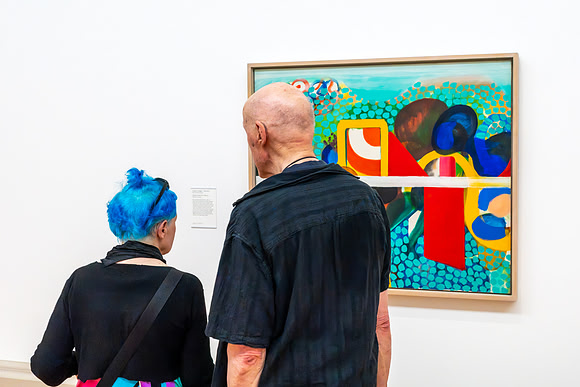
I only managed to take one decent photo in the three galleries I visited. The photo captures a couple: a shaven-headed older man and an older woman with blue hair. The woman’s blue hair and the colours in her skirt echo the colours in the painting behind her. This is either coincidence, or the woman is a Hodgkin fan. Hard to know really, but I was there at the right time to make the connection.
Learning to See
As I mature as a photographer, I take fewer and fewer photographs. It’s not because I have lost my appetite for the art form; it’s just that I have a greater awareness of what will work as a photograph. Coming home with one or two good photos in a day is OK with me, instead of a hundred average ones.
To be honest, it is a lottery with the way I work. I simply plan what route I am taking on the day and what I want to see. What presents itself in front of my eyes is predictable in terms of the built environment, but I have no control over the people who inhabit that space. So, it’s pot luck really.
There is an unpredictability to that approach, but an excitement as well. You have no idea who will present themselves to you at a specific time in a specific location. The good thing about that, and about street photography, is that your photos are unique to you. Despite photographing in the same locations as countless other photographers, the people who inhabit these spaces at that particular moment are unique to your photograph.
The more I do photography, specifically street photography, the more I find out about myself. I’m an observer. I notice things. I scan what is around me and make decisions about what is worth capturing. It’s a reaction to visual stimuli that resonate with me for one reason or another. What we choose to photograph is shaped by what we have seen and learned in the past, so inevitably there is something of ourselves in the photographs we make.
The brain works very quickly in street photography situations. Often, you only have seconds to react to something that presents itself in front of you. Sometimes you instinctively know there is a photograph there, even if your conscious brain hasn’t quite figured out why yet. I have often come back to the studio and discovered connections in photographs that I wasn’t consciously aware of when I took them.
I remember taking a photo in Brussels of a guy wearing a jacket with a red skeleton on the back. At the time, I was simply intrigued by the jacket. When I got back to the studio, I noticed a sign in the background that said ‘Back Factory’. Somehow, I had managed to position the guy’s jacket and the sign perfectly within the composition, yet I had absolutely no recollection of seeing the sign when I took the photograph.
You could dismiss that as coincidence, but I’m not so sure. I have been making images for a long time, from my art school days in the mid-nineties to the present day. After all those years of looking, composing and making images, I think you become wired to see certain visual connections. Sometimes the eye reacts before the conscious mind catches up.
The same thing happened with the photograph I took of the woman standing in front of the Howard Hodgkin painting in Tate Britain. I took the photograph instinctively. At the time, it didn’t fully register with me that the blue of her hair and the colours in her skirt echoed the colours in Hodgkin’s painting. The connection only became fully apparent later when I looked at the image on my laptop.
The Discreet Camera
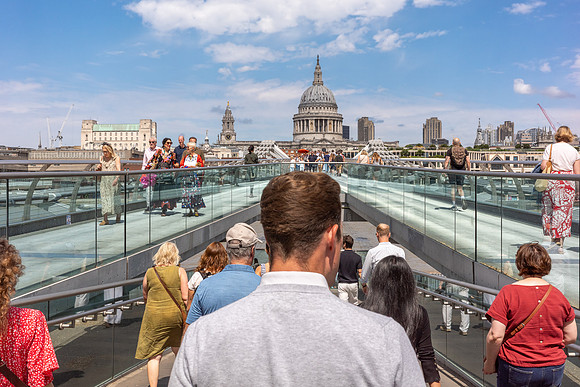
For this trip, I only brought my Ricoh GR IIIx with its 40mm lens. This little camera makes me look like a tourist from a bygone age, resembling a point-and-shoot camera from the early noughties. I’m not sure that this illusion really works. It’s the stare that’s the giveaway that you are a photographer. People are not usually looking so hard at what is in front of them. People on the street can see you for what you are: a magpie looking for trinkets.
That said, the GR is far more discreet than the Canon 5D Mark III I once used. You can sometimes fool the public into thinking you are just another tourist and that you are photographing something other than them: some architectural feature, or just a snapshot memory that will end up on a hard drive, never to be seen again.
There is a certain amount of dishonesty to this approach, a sneakiness, if you will. It often plays on my conscience and, on occasion, has taken away from the enjoyment of taking photos. You get that look sometimes when a person, or persons, realise you have deliberately captured them. It can feel uncomfortable.
Capturing everyday life as it unfolds is the objective, so by its nature, street photography must involve a degree of discretion and purposefulness if you want to capture genuinely candid moments. I truly believe in this genre of photography. For me, it is the most exciting and, on occasion, gratifying approach to making pictures. There is an unpredictability to it that keeps me coming back for more.
Camera Settings
Let’s talk a little bit about settings. I know some photographers would rather hear about the technical side of things than the philosophical and moral side of photography.
I remember doing a talk to a camera club over a decade ago after returning from a trip to Iceland. As I was talking to the group, I noticed some of the members sitting with folded arms. I was wondering to myself, what am I doing wrong? Was my presentation not interesting?
What I didn’t realise was that they weren’t too interested in me talking about concepts and ideas or my approach to making photographs. They just wanted to know what gear I used and how I post-processed my imagery. So, I learned my lesson, and here is some information on my camera settings.
Camera: Ricoh GR IIIx – 40mm fixed lens
Exposure settings:
- Aperture: f/11 – I get plenty of depth of field with this aperture.
- Shutter speed: 1/400 sec – I can freeze people moving relatively fast with this shutter speed.
- ISO: Auto – I let the camera figure out the ISO after setting the aperture and the slowest shutter speed I want the camera to use.
I work in Aperture Priority mode (Av), and in the ISO menu settings I have the minimum shutter speed set to 1/400 sec. I set the focus to Auto-area AF but sometimes switch to Zone Focus, which I have set to 2.5 metres. I have customised the Fn button to switch between autofocus and zone focusing.
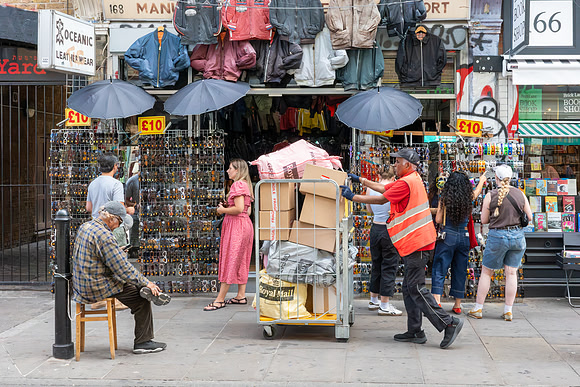
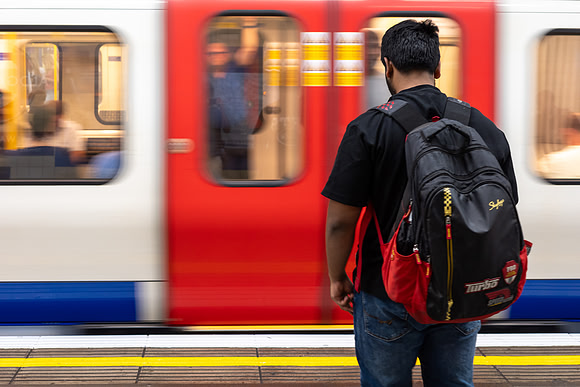
If I’m doing panning or long exposures, I switch to Tv mode and adjust the shutter speed to the desired duration for the effect I want. For panning shots, I usually set the shutter speed to around 1/8 sec. For some of the photos I took at the Tube station, I set the shutter speed between 1/4 and 1/20 sec, depending on how much blur I wanted.
The Ricoh GR IIIx has in-body image stabilisation (IBIS) built in, so you can hand-hold the camera at slower shutter speeds and get that combination of sharp and blurred elements in the photograph without using a tripod.
London – I’ll Be Back
Going back to London, this time with the intention of taking photographs, has whetted my appetite for more. Four days barely scratched the surface. It’s a massive city, and for a street photographer the constant flow of people against an ever-changing urban backdrop means there is always the possibility of a photograph around the next corner.
That, I think, is what will bring me back. There are still so many parts of London I haven’t explored and countless photographs that, for now, simply haven’t presented themselves to me.
Hopefully, I’ll be back soon.
See all images taken on my London trip here:
https://www.kevinlangan.ie/london