Thanks for visiting!
This blog is where I share stories behind the images, thoughts on the creative process, and insights into the gear and techniques I use.
Whether you're here for inspiration, curiosity, or connection, I hope you find something that resonates. Feel free to explore, comment, and come along for the journey.
The choices we make!
Recently after showing one of my latest images to close relation, the reaction I got was " why on earth did you photograph such an uninteresting thing".
Of course I had photographed it because I personally found it visually interesting in the first place. I also could visualise before I made the photograph that it would make a nice black & white print with lot's of character.
The idea for this image has been sitting in my head for a number of weeks now. Ever since I acquired a 10 stop Neutral Density filter I have been playing with the concept of "clean space", particularly working with black & white imagery.
To achieve the desired effect of "clean space" a long exposure is required. By long I mean one minute plus and for this particular exposure it took four minutes. To achieve a lengthy exposure like this you need a Neutral Density Filter. A ND filter is a device for reducing the amount of light entering the lens, thus affecting the lenght of the exposure time. ND filter are graded in terms of stops, e.g. 1, 2, 3, 10 etc. A 10 stop ND filter reduces the light intake by ten stops. Without getting too technical, the exposure for this particular shot took 4 mins with the10 ND stop filter.
The effect of such a long exposure on the water surrounding the pier was to soften and flatten it. With the pier in sharp focus, thanks to the camera being set-up on a tripod, the contrast between the soft water blur effect and the hard edges of the pier took attention away from the water and onto the point-of-focus, the pier itself.
As well as abstracting the image with the effects of a long exposure, converting the image to black & white also added to the abstraction of the image. Given that we see in colour, stripping an image of it's colour is a form of abstraction in itself. When colour is removed from an image our brains read black & white imagery in term's of brightness (luminosity), distribution of tones, texture and the structure of the form's recorded.
For me this image was always going to be a black & white image. The colour version of the image is visually uninteresting and distracts form the detail in the wrought iron frame and wooden beams. Given that the structure of the pier is what drew me to photograph it in the first place, a black & white conversion was always going to be preferred to a colour version of the same image.
With a combination of a long exposure and a black & white conversion I believe I was successful in creating a strong image, one that focuses attention on the structure of the pier, with it's wonderful detail and textures and away from all other unwanted distraction.
I guess what we choose to photograph and how we go about creating the final image defines us as photographers. Taste is another matter and one that requires a lot more discourse than a few paragraphs in a blog!
Till next time, happy snapping! Or should that be happy visualisation, camera set-up, post-production and printing!
Of course I had photographed it because I personally found it visually interesting in the first place. I also could visualise before I made the photograph that it would make a nice black & white print with lot's of character.
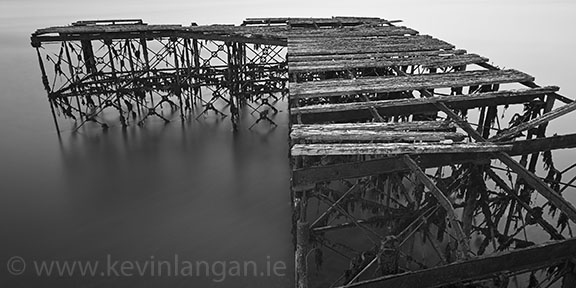
|
| Glin Pier |
The idea for this image has been sitting in my head for a number of weeks now. Ever since I acquired a 10 stop Neutral Density filter I have been playing with the concept of "clean space", particularly working with black & white imagery.
To achieve the desired effect of "clean space" a long exposure is required. By long I mean one minute plus and for this particular exposure it took four minutes. To achieve a lengthy exposure like this you need a Neutral Density Filter. A ND filter is a device for reducing the amount of light entering the lens, thus affecting the lenght of the exposure time. ND filter are graded in terms of stops, e.g. 1, 2, 3, 10 etc. A 10 stop ND filter reduces the light intake by ten stops. Without getting too technical, the exposure for this particular shot took 4 mins with the10 ND stop filter.
The effect of such a long exposure on the water surrounding the pier was to soften and flatten it. With the pier in sharp focus, thanks to the camera being set-up on a tripod, the contrast between the soft water blur effect and the hard edges of the pier took attention away from the water and onto the point-of-focus, the pier itself.
As well as abstracting the image with the effects of a long exposure, converting the image to black & white also added to the abstraction of the image. Given that we see in colour, stripping an image of it's colour is a form of abstraction in itself. When colour is removed from an image our brains read black & white imagery in term's of brightness (luminosity), distribution of tones, texture and the structure of the form's recorded.
For me this image was always going to be a black & white image. The colour version of the image is visually uninteresting and distracts form the detail in the wrought iron frame and wooden beams. Given that the structure of the pier is what drew me to photograph it in the first place, a black & white conversion was always going to be preferred to a colour version of the same image.
With a combination of a long exposure and a black & white conversion I believe I was successful in creating a strong image, one that focuses attention on the structure of the pier, with it's wonderful detail and textures and away from all other unwanted distraction.
I guess what we choose to photograph and how we go about creating the final image defines us as photographers. Taste is another matter and one that requires a lot more discourse than a few paragraphs in a blog!
Till next time, happy snapping! Or should that be happy visualisation, camera set-up, post-production and printing!
Framed 30"X20" Print for Sale!

|
| 30"X20" Framed Print - "Frosty Morning, Back of the Hill" |
"Print Sale" Tarbert Community Centre
Thanks to everyone who attended my print sale at the weekend. I was delighted with the turnout and the support I received from the Tarbert community and beyond...I'm considering having another one over the Christmas period at the same venue..Keep an eye out on my website for details...Below are some picks from the weekend.


|
| Me! |

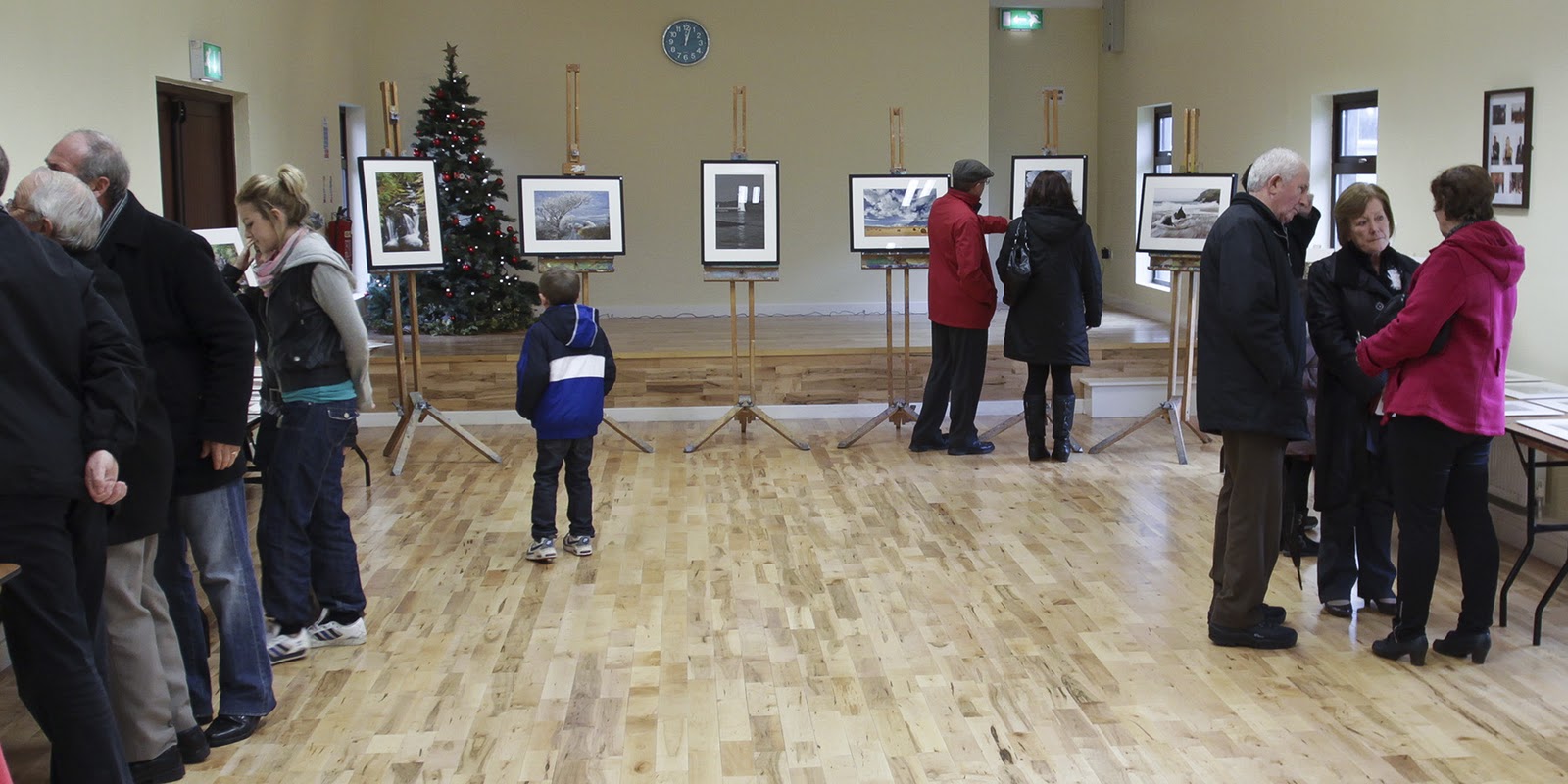

Print Sale Tarbert Community Centre
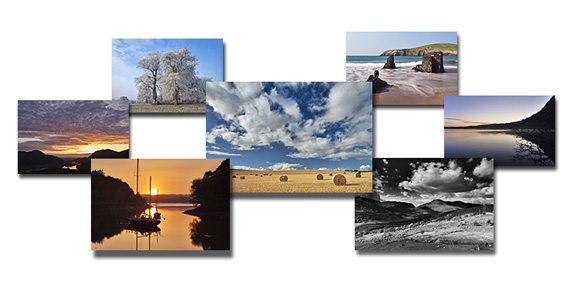
I am having a "print sale" in the Tarbert Community Centre on the 10th Dec 8pm-10pm and on the 11th Dec 11.30am-1.30pm. There will be a selection of print sizes and formats from my collection, mounted and rapped in cellophane. I will have a few framed as well. All are welcome!
Light Painting
Abstracting forms using a combination of slow shutter speeds and camera movement can sometimes lead to very pleasing results. It is a technique I have used in the past, but rarely in the genre of landscape photography.
Having trained originally as a painter I love the way this technique abstracts the photographic image, shifting concentration away from recognizable detail to the formal elements of colour, texture and tone.
The level of abstraction created by this technique depends on the length of exposure and the amount of camera movement during the exposure. Personally I like to retain some degree of recognizable elements in my composition. Choosing a shutter-speed around the 1/15s to 1/4s range allows me enough time to create movement in the image while still retaining enough detail to make the image look recognizable.
Along with the relatively long exposure time used to abstract the image, the direction you "drag" the camera during that exposure is also very important is defining the overall effect you get.
A good rule-of-thumb is to move the camera with the natural lines in the landscape. This will help you maintain the integrity of the forms in the image while blurring their boundaries to give a more abstract effect.
This time of year really compliments this technique, especially in woodland areas where there is a broad pallet of colours to play with. On a bright autumnal day the results can be stunning, with complimentary colours merging into one another to make really strong and beautiful imagery.
For more examples of this technique visit my website at: www.kevinlangan.ie

|
| Golden Tree |
Having trained originally as a painter I love the way this technique abstracts the photographic image, shifting concentration away from recognizable detail to the formal elements of colour, texture and tone.

|
| Tree Forms |
The level of abstraction created by this technique depends on the length of exposure and the amount of camera movement during the exposure. Personally I like to retain some degree of recognizable elements in my composition. Choosing a shutter-speed around the 1/15s to 1/4s range allows me enough time to create movement in the image while still retaining enough detail to make the image look recognizable.
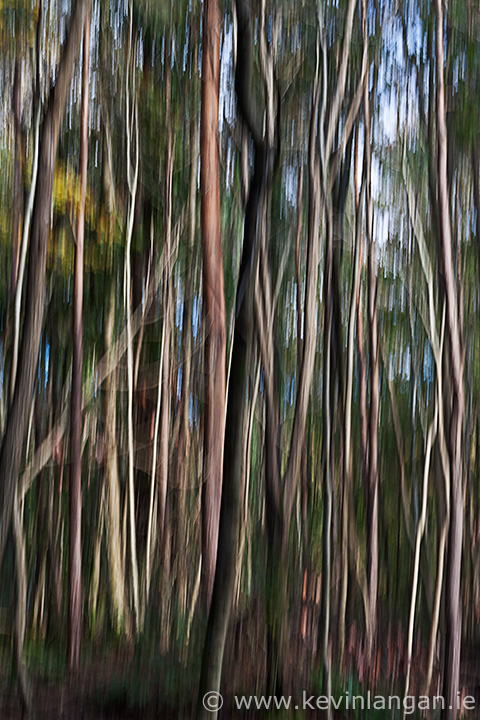
|
| Linear |
Along with the relatively long exposure time used to abstract the image, the direction you "drag" the camera during that exposure is also very important is defining the overall effect you get.
A good rule-of-thumb is to move the camera with the natural lines in the landscape. This will help you maintain the integrity of the forms in the image while blurring their boundaries to give a more abstract effect.

|
| Reed Mace |
This time of year really compliments this technique, especially in woodland areas where there is a broad pallet of colours to play with. On a bright autumnal day the results can be stunning, with complimentary colours merging into one another to make really strong and beautiful imagery.
For more examples of this technique visit my website at: www.kevinlangan.ie
Colour in Motion
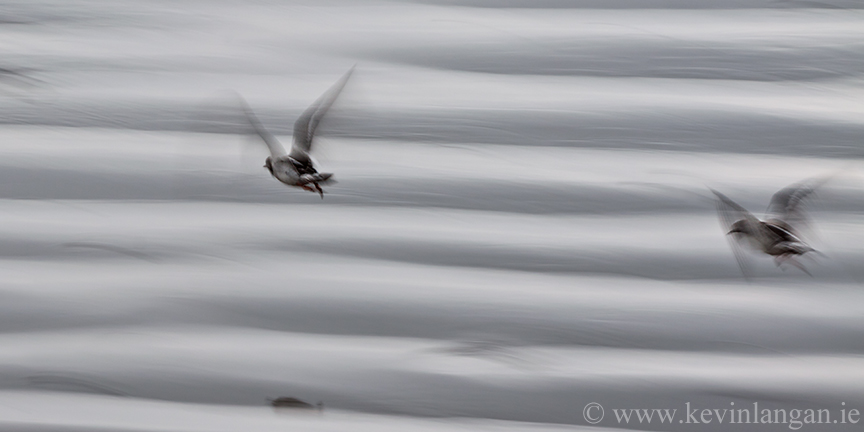
"Panning" is a technique I used quite a bit in my student days at art college. It was a technique that served me well in creating a sense of movement and dynamism in the urban photography I was producing at the time.
Recently while looking through some old photos from my college days I was reminded what a great technique it was. I always loved how colour and form was abstracted by this technique and the painterly effect it produced.

|
| Gulls |
Recently while looking through some old photos from my college days I was reminded what a great technique it was. I always loved how colour and form was abstracted by this technique and the painterly effect it produced.
|
| Kinetic Energy |
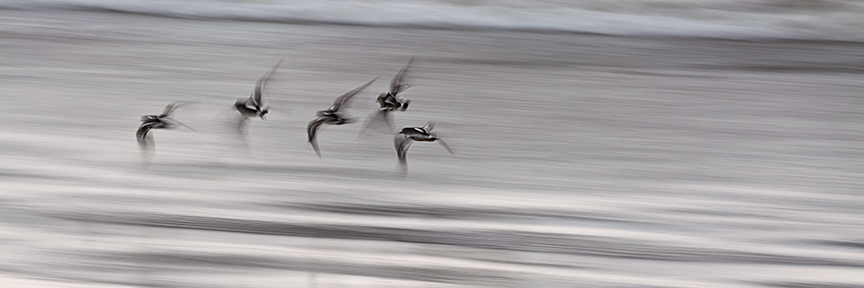
The basic idea behind panning is that you pan your camera in time with the moving subject and end up gettinga relatively sharp subject with a blurry background. How sharp the subject you are focusing on depends on the shutter speed you are using.
|
| Skimming Turnstones |
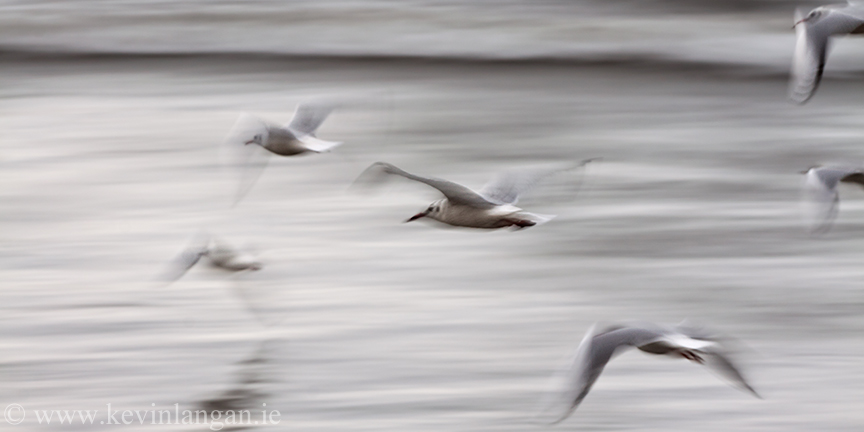
For this series of images of birds in flight I wanted to make the end product fairly abstract while still retaining enough detail to make the subject matter recognizable.
Using a relatively slow shutter speed (1/25s - 1/15s) allowed me to blur and abstract the background while still retaining some detail in the birds. To retain some detail in the birds I panned my camera in the same direction as the birds in flight and at their speed of flight.
|
| Gulls III |
The weather conditions along with the monochrome background of the surf also helped highlight the subtle colours of the birds in flight. Colour fades in motion and becomes more transparent the longer the exposure; because of this I choose a shutter speed that would retain some solid colour in the moving forms while making the background more abstract and soft.

|
| Gulls II |
This technique can also be used with a flash in closer proximity to the subject. With a long exposure, when fired, the flash will freeze forms in the foreground while the panning effect of the camera will blur the background into abstraction.
I really love this technique and I hope to use it more in the future. Try it out for yourself and you'll be amazed with the results!
To view high-resolution versions of these images go to: www.kevinlangan.ie
Hurricane Katia hits the West Coast
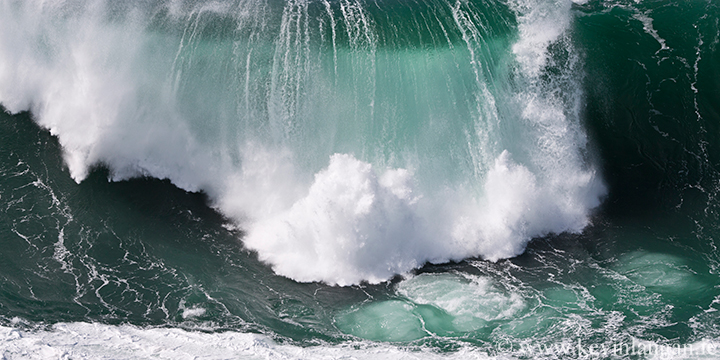
With the tail end of Hurricane Katia hitting the west coast of Ireland, I headed for Loop Head in County Clare.
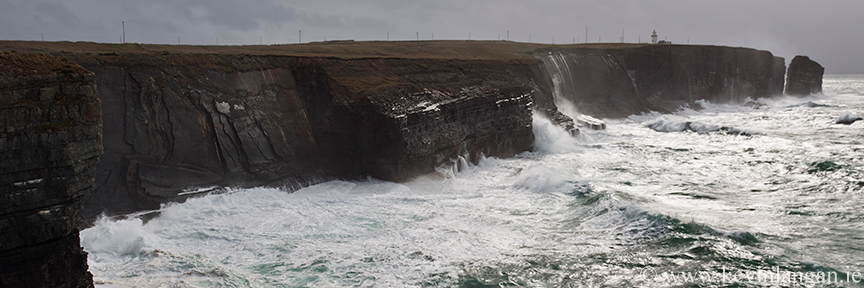
Loop Head is a finger like peninsula jutting out into the sea on the Clare coast. To the south of the peninsula is the Shannon Estuary, while to the west and north, the peninsula is bounded by the mighty Atlantic Ocean.

|
| Seabirds in Flight at Loop Head |
Loop Head is a finger like peninsula jutting out into the sea on the Clare coast. To the south of the peninsula is the Shannon Estuary, while to the west and north, the peninsula is bounded by the mighty Atlantic Ocean.
|
| Giant Wave off Loop Head |
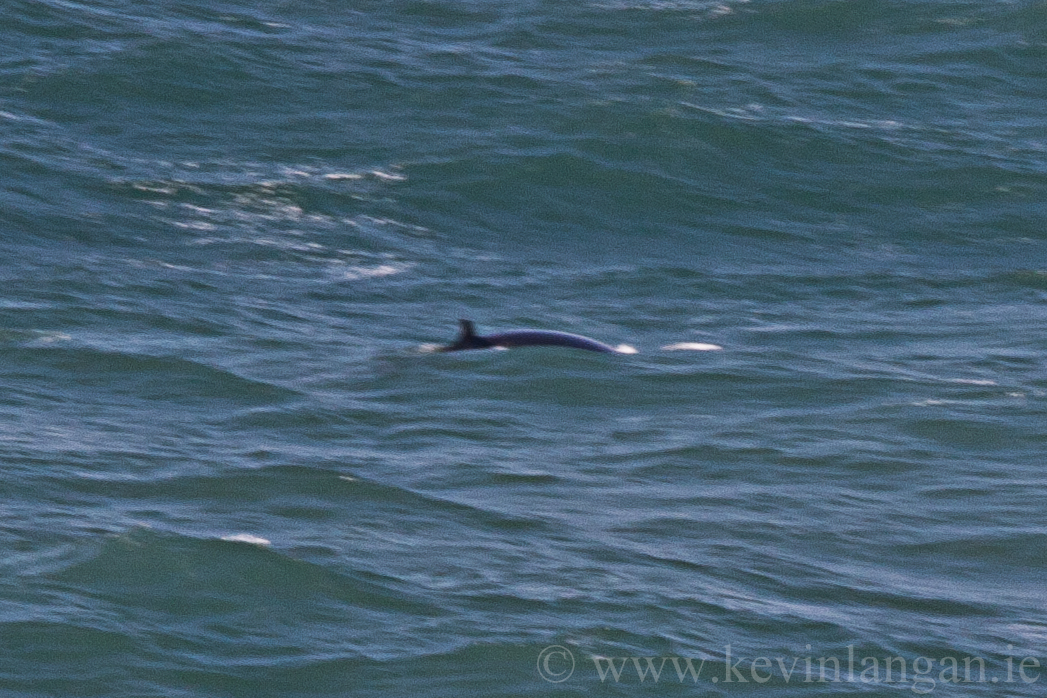
Apart from the amazing scenery, Loop Head has a lot to offer in terms of wildlife. Minke whales are seasonal visitors to Loop Head around September and October each year, attracted by the spawning herring shoals.
As I was photographing along the headland a Minke surfaced briefly, but unfortunately I was too slow to catch it on camera. A litter later, further down the coast I managed to get a blurry snap as one surfaced further out.
|
|
Minke Whale off Loop Head |
As I was photographing along the headland a Minke surfaced briefly, but unfortunately I was too slow to catch it on camera. A litter later, further down the coast I managed to get a blurry snap as one surfaced further out.
|
| Immature Herring Gull glides on updraft |
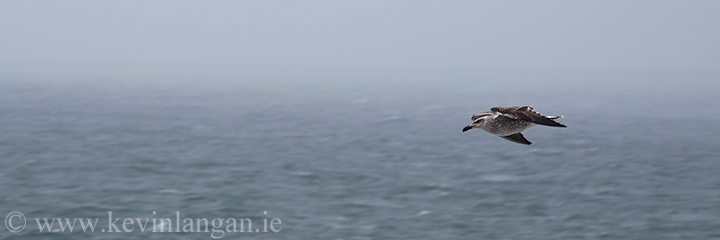
There is also a large variety of seabirds to be seen at Loop Head. I was treated to an exciting aerobatic and diving display by a variety of birds, including; Herring Gulls, Shags, Cormorants, and Choughs.

|
| Chough glides above the surf |
With winds speeds reaching 40 mph it was difficulty enough to keep ones feet, let alone take photographs. By the time I got back to the car, after several hours shooting, I was glad to be in out of the elements.

|
| Loop Head Lighthouse |
|
| Loop Head Headland |
Despite the hardship endured, photographing in such conditions can be very rewarding. It's hard to beat high winds and rolling seas to add drama to a coastal scene. That combined with the spectacular scenery, its hard not to product good photography.
For more photos of Loop Head go to: www.kevinlangan.ie
For more photos of Loop Head go to: www.kevinlangan.ie

Resolution and the Printed Image
Free tutorial examining the link between image resolution and print resolution and how to optimize you images for perfect prints!
Follow link for free tutorials: www.kevinlangan.ie/photographytutorials
Follow link for free tutorials: www.kevinlangan.ie/photographytutorials
Dunmore Head Dingle Peninsula
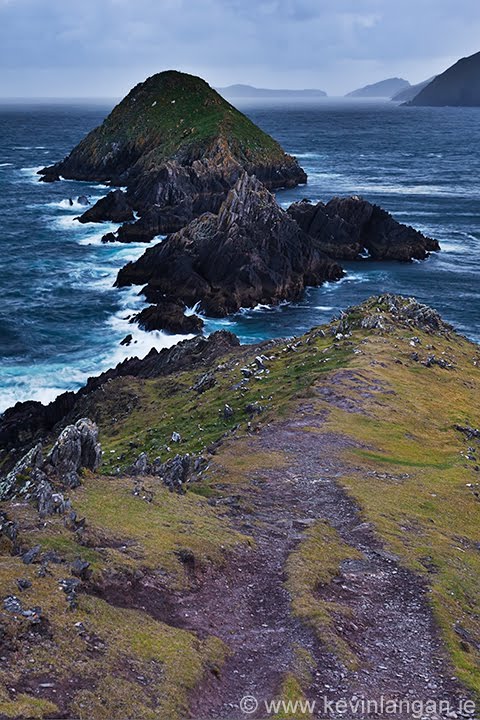
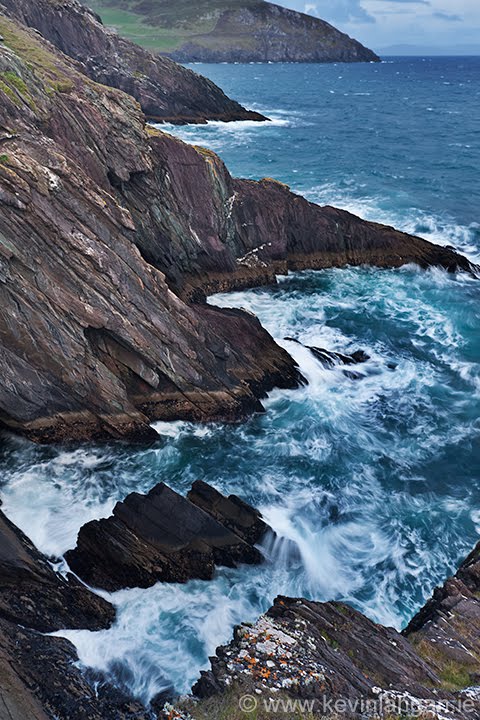
On a recent trip to Dingle I met a French man looking for directions. He was looking for the most westerly point in Europe and I duly obliged by pointing him in the direction of Dunmore Head. Following my encounter with the French man I decided venture there myself on a wild and wet evening in late summer.
I believe the west coast of Ireland is best experienced when the waves are bashing against the rocks and sky is dark and moody. In saying that, shooting in such conditions has it own complications. Battling with the wind and rain can often be an uphill battle. When standing upright is a task in itself, you can imagine the difficulty encountered when trying to capture a good exposure. Rain is also a difficult one to deal with, keeping the front element of your lens dry and free of fog is a constant battle.
Despite it's complications, there is a great sense of feeling alive in such conditions. You really feel like you are part of nature when you are being battered by the elements. I always feel refreshed after such outings, both physically and spiritually. Nature has that effect on the soul, an effect I feel we all need from time-to-time to revive our spirits.
There is a surreal element to the experience as well. As I stood there on the edge of Europe looking out over the Blasket Sound, I felt like I was in a movie theatre watching a blockbuster, with each scene unfolding before my eyes. As rain fell over the Blasket Islands, I was mesmerize me to the point of paralysis. It was like being suspended in time, bit like the matrix really, well not quiet.
For more photo's of the Dingle Peninsula go to:
www.kevinlangan.ie
|
| Dunmore Head Dingle Peninsula |
I believe the west coast of Ireland is best experienced when the waves are bashing against the rocks and sky is dark and moody. In saying that, shooting in such conditions has it own complications. Battling with the wind and rain can often be an uphill battle. When standing upright is a task in itself, you can imagine the difficulty encountered when trying to capture a good exposure. Rain is also a difficult one to deal with, keeping the front element of your lens dry and free of fog is a constant battle.

|
| Dunmore Head Edge of Europe |
Despite it's complications, there is a great sense of feeling alive in such conditions. You really feel like you are part of nature when you are being battered by the elements. I always feel refreshed after such outings, both physically and spiritually. Nature has that effect on the soul, an effect I feel we all need from time-to-time to revive our spirits.
|
| Dunmore Head |
There is a surreal element to the experience as well. As I stood there on the edge of Europe looking out over the Blasket Sound, I felt like I was in a movie theatre watching a blockbuster, with each scene unfolding before my eyes. As rain fell over the Blasket Islands, I was mesmerize me to the point of paralysis. It was like being suspended in time, bit like the matrix really, well not quiet.
For more photo's of the Dingle Peninsula go to:
www.kevinlangan.ie
© Kevin Langan